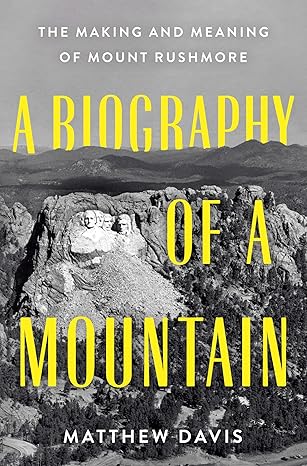
Description
A comprehensive narrative history of Mt. Rushmore, written in light of recent political controversies, and a timely retrospective for the monument’s 100th anniversary in 2025
“Well, most people want to come to a national park and leave with that warm, fuzzy feeling with an ice cream cone. Rushmore can’t do that if you do it the right way. If you do it the right way people are going to be leaving pissed.”
Gerard Baker, the first Native American superintendent of Mt. Rushmore, shared those words with author Matthew Davis. From the tragic history of Wounded Knee and the horrors of Indian Boarding Schools, to the Land Back movement of today, Davis traces the Native American story of Mt. Rushmore alongside the narrative of the growing territory and state of South Dakota, and the economic and political forces that shaped the reasons for the Memorial’s creation.
A Biography of A Mountain combines history with reportage, bringing the complicated and nuanced story of Mt. Rushmore to life, from the land’s origins as sacred tribal ground; to the expansion of the American West; to the larger-than-life personality of Gutzon Borglum, the artist who carved the presidential faces into the mountain; and up to the politicized present-day conflict over the site and its future. Exploring issues related to how we memorialize American history, Davis tells an imperative story for our time.
Read more


FullyBookedInKentucky –
A Biography of a Mountain is one of those history books that hits you with truth, beauty, and discomfort in the best possible way. Matthew Davis takes the familiar image of Mount Rushmore and cracks it open, showing the layers of ambition, conflict, artistry, and injustice that shaped it. Instead of treating the monument like a polished postcard, he digs into the land itself and the people who lived, fought, carved, and grieved around it. I loved how Davis balances the awe of creation with the ache of what was taken. This feels less like a national landmark biography and more like a reckoning with how America decides what stories to carve into stone and which ones it quietly buries. It is thoughtful, unflinching, and unexpectedly emotional. I walked away seeing the mountain differently and I think most readers will too
June Price –
Part memoir, part solid research project, I have to let you know up front that this one isn’t an easy read. Despite the author’s personal notes that help us understand his connection to Rushmore, the deep dive into the basic divides in cultural reaction to the setting make this an interesting, if not always easy read. Don’t get me wrong. It reads fine. It’s the topics, focusing on the concept of Mount Rushmore as a patriotic symbol, while acknowledging it’s spiritual importance and meaning to Native Americans, particularly the Lakota Sioux, that make it a read that requires thought. Both sides have something worth conveying, so kudos to Davis for his effort to be even-handed while presenting the varying viewpoints and, trust me, it isn’t even simple to break it down into the two most compelling ones.
I obviously won’t rehash the contents but will say that those willing to set aside preconceived notions and read with an open mind may come away still divided. Why can’t it be both? Both patriotic and spiritual, so to speak. The divides in our country are vast and this is just one of many. Davis’ visits with various citizens of the Black Hills area were interesting, including the times he encountered residents who had never actually visited Rushmore. Living in Alaska with countless sights, I had to sympathize a bit as, well, you do tend to take things that are practically on your home turf for granted. Having a family tree that goes back to not just the Pilgrims and Jamestown settlers but the native population that surrounded them, my tendency is to go with the spiritual aspects but, well, despite the sculptor being a supporter of the KKK, sigh, it does shout American strength and forward thinking, too, both of these being aspects that have made progress possible. In other words, my brain was pinging and ponging back and forth as I read, which isn’t a bad thing. Tiring but a sign the words were having an impact. Davis’ efforts to remain unbiased, to be fair to all, worked, in other words, for the most part.
Bottom line, while it wasn’t the light read I was expecting and I wish there had been photographs, I found this an intriguing read. His personal stories (he was eventually heading to Mongolia when he first visited the site, no lie…what a detour) and meeting the people of the area give it a personal touch, too, albeit it seemed to veer from that lighter tone to serious talk without much true transition. It was fun to know the role his son’s birth had to the book. I applaud him for not avoiding the more negative aspects of the history of Mount Rushmore and the Black Hills area, either, from the often troubling history of sculpture Borglum to working in conversation about the Lincoln Memorial and slave Archer Alexander, an ancestor of boxer Ali amidst the history of the site from both white and Native (largely Lakota Sioux) vantage points. As he noted at one point, writing the book made him ponder what it truly means to be American. My thanks to #StMartin’sPress and #NetGalley for allowing me this early look at this insightful, thoughtful look at one of America’s best known symbols. Yes, symbols matter.
C. Pickel –
A great read — and earns its title, as it delivers the kind of layered “biography” of a mountain that’s usually reserved for people. Matthew Davis weaves together a narratives and perspectives across time, place, and people to show how complex Mount Rushmore was to make and how complex it remains today. He also shows how Mount Rushmore intersects with so many other names, events, and inclinations in American history — from Custer to Crazy Horse, from the Gold Rush to urge to build memorials, from the Lakota who’ve lived in the Black Hills for centuries to the early-American pioneers who saw those hills as a new land of opportunity. All of the questions and complexity (and just plan solid writing and storytelling) kept me flipping the pages and gave me a new, enriched sense of what Mount Rushmore is and what it represents. And heading into America’s 250th, seems like no better time to read a book like this. Literary nonfiction done right.
S. Mahaffey –
Matthew Davis offers a complicated history of the 60-foot-tall faces of four presidents carved into the Black Hills of South Dakota. He has drawn on archival sources, his own travels, and interviews with locals. Mt. Rushmore’s story is one of disputed claims and hidden origin including the bloody slaughter of the Indigenous people who inhabited the site, to the shadowy past of its sculptor, Gutzon Borglum. A KKK supporter, Borglum was recruited in 1927 because of his work on a Confederate monument in Stone Mountain,. Borglum refused to participate in a scheme to embezzle Stone Mountain’s federal funding for the KKK. The historian Doane Robinson saw it as a monument to the frontier, with early attractions including likenesses of Red Cloud and George Custer. While that meaning was obscured by the choice to carve U.S. presidents, the intention remains like a dark undercurrent, the author shows, with examples of how Rushmore continues to be a “flash point” between white and Native residents. It’s present a fuller representation of a murky past for Mt. Rushmore.
It is am amazing and fascination book to read. I have briefly seen Mt. Rushmore as I was driving to California. I had no idea of the history of it. I think that this an important part of the United States history that is overlooked by many—we just see the presidents and don’t think of how it came about. I am going to read this book again as the information is fascinating. Anyone who enjoys reading history and/or Mt. Rushmore would enjoy reading it too.
Disclaimer: I received an arc of this book from the author/publisher from Netgalley. I wasn’t obligated to write a favorable review. The opinions expressed are strictly my own.
TD –
This engaging non-fiction book reveals the fascinating story behind Mount Rushmore. By presenting both the achievement and the controversy, Matt Davis offers a powerful, eye-opening perspective on one of America’s most famous monuments. It’s a compelling read that leaves you wanting to learn more—and makes a thoughtful Christmas gift for history lovers.
Barbara H. Flynn –
A rich & wonderful book!!
suzanne a schenck –
Excellent book – well written and well researched.